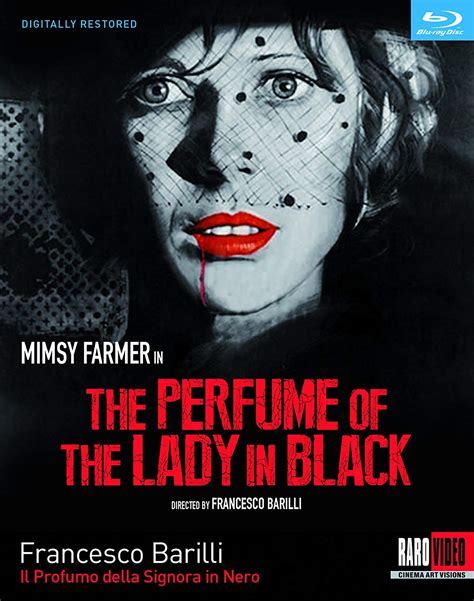
Perfume of the Lady in Black (1974) Italian giallo

Oh, Kittymuffins, is this a humdinger of a film! This might, just might, bounce Bird With Crystal Plumage out of the #1 spot in my favorite giallo list.

Where to start…

It has all the best elements of a great giallo, plus Mimsy Farmer–she’s terrific.

If you aren’t familiar with the genre, here’s a quick catch up. In the late 50s or thereabouts, a German production company got rights to do a series of films based on Edgar Wallace novels. They were usually in black and white with less than stellar acting, a good bit of camp, some detection, some slasher stuff. They’re called krimi (=crime). About the same time, this type of thing caught on in Italy. They derived from cheap pulp novels published with predominantly yellow covers. Giallo means yellow. The giallo genre runs a spectrum from gory sadistic slashers (not my thing) to detective story. Anything mystery/thriller/horror/supernatural. But there are some elements to a giallo that make it a giallo: masked killer in designer leather shoes, paranoia, helpless heroine —

Mystèrew, I find this trope surprising really. I watched a fair number of Sophia Loren films and as I recall, she was not a shrinking violet who would just cower against the wall as the killer came at her holding a knife. And older Italian women look pretty tough–like collectively they would beat anyone to death with skillets and rolling pins while their hair remained perfect, protected in kerchiefs, know what I mean? Anyway, the trope is usually gorgeous women whose clothes seem to fall off easily (fire the tailors!) and are ridiculously easy targets. In The Killer Reserved Nine Seats for example, a woman in a cocktail dress and three inch heels goes poking about in a basement. “Hey, crazy killer– come find me! No one could possibly rescue me here! You can’t miss me, I’m sparkling in my dress and click-clacking in my heels!” But not always. Mystere is a glorious departure from this. Wish they’d make a series. She’s fabulous.

Where was I? Oh yes, giallo elements. Lots of red herrings and mystery, and sometimes, like with this one, a saturation of gorgeous colors. Plot aside, this is a luxurious film cinematically speaking. Good thing colors don’t have flavors (unless perhaps you have synesthesia, in which case, I really want to know what that blue in the bedroom tastes like!) or you’d be wanting to lick the screen.

The plot is pretty simple: Sylvia is either a chemist or a manager of a perfume company. She is invited to a gathering of friends and the discussion veers into the dark arts of witchcraft in Africa. It is explained that when a sacrificial subject is chosen, he/she will gradually descend into madness. From this moment, Sylvia begins to experience hallucinations that become increasingly more bizarre and it is obvious that her sanity has broken free from its mooring. We learn more of her backstory, including trauma from the suicide of her mother, whom she remembers sitting at her dressing table in a black dress with white polka dots, spraying herself with perfume. I don’t want to give away much more, but I will say that the ending is quite a shock. You almost feel like that time at the theater where you went to the bathroom and accidentally returned to the wrong theater. What? Zombies? This can’t be right. Oops! Wrong film! Only it’s not.

Now here’s the thing. Up until the ending, you think you know what’s going on. As the credits role, you will probably have questions, as I did. “But…but…huh? What about–?” And while the first half of the film is pretty tame relative to the hack-and-slash gialli, it does get to the blood splatter eventually. I’m going to assume that if you are going to give this one a go, you can handle that. Brace yourself for the ending though.

I’ll be honest, I had to hunt up reviews so someone could explain the ending to me. So glad I did! Many thanks to giallo aficionado, Carlin Cook. I add the link to his review below. His take on it, and I totally agree, is that this film is similar to Identity and the ending is not literal but symbolic. Carlin suggests, and I agree, that multiple viewings would reveal just how amazing this film is–so much subtle symbolism and plot hints along the way.

FIVE MONKEYS!

Here’s a link to a video explaining the giallo genre that includes pics of the original giallo book covers:

https://www.youtube.com/watch?v=dU3nyeFiDK4

Here’s a link to Carlin Cook’s review on YouTube:
https://www.youtube.com/watch?app=desktop&v=l5MkkiEDp5Q&fbclid=IwAR3IKG4sUbDq92VlOEEKQt9w-75DKp4EwsuCyZeBlqKsQo8acCbA3c-qcbY

Fitzcarraldo 1982 (German w/subtitles)

Director: Werner Herzog Klaus Kinski, Claudia Cardinale

BAFTA Award: Best Foreign Language Film

Golden Globe Award Best Foreign Language Film

Cannes Film Festival: Best Director

This became a controversial film relating to whether Herzog exploited the indigenous people of the Amazon during the making of it. Filming was originally supposed to take three months and star Jason Robards and Mick Jagger. But 40% into filming, Robards got sick, delays conflicted with Jagger’s schedule, so the film was scrapped and re-written for Herzog’s “Best Fiend” (no, not a typo), Klaus Kinski. If you aren’t familiar with Kinski, he was a talented but extremely volatile actor. He and Herzog had one of the strangest bromances of all time, they loved each other, respected each other, but often contemplated killing one another or dying together. I should add here that Kinski was willing to stay on the boat to film it going through ridiculously dangerous rapids and said something to Herzog to the effect that if you go down, I will go down with you. Eleven months in the jungle making a monumentally difficult film would test anyone. Doing it with Kinski… Herzog was approached by one of the indigenous extras who asked if Herzog would like him to kill Kinski. Herzog’s reputation wasn’t exactly magnanimous either–he could be quite the task master. But clashing egos was just one side of this daunting, complicated, hubris-packed project.

This wildly ambitious project was plagued with tragedies and setbacks. A plane crash. The boat ran aground on a sand bar and delayed filming. Heavy rains stopped filming. There were accidents, deaths and major injuries including arrow wounds inflicted by an irate tribe. A cameraman’s hand was ripped open and there was no anesthesia left for the 2.5 hour surgery to put his hand back together (it had already been used up in a prior accident). (Link to article below)

The plot is simple and straightforward: a crazy Irishman, mad about opera, has a chance to get rich in the rubber industry, but to do so, he must get his newly acquired land and show signs of productivity in a given amount of time. (I think it was a year, but I may be mistaken.) He hatches a wild idea about getting the boat over the mountain and approaching the land from an otherwise not accessible river.

The story is loosely based on a true story of an Irishman in the rubber industry who got the idea to move a boat from one river to a nearby river by hauling the boat parts over a mountain and constructing it on the other side. In the film however, he hauls the finished boat over the mountain. Not wanting to rely on computer graphics, Herzog determined to haul a real boat up the mountain. (An environmental issue, there were three boats used during the film and the one that got up the mountain is still there. It was left. Not sure how it is being used currently–is it a gift shop or a rusting wreck? I don’t know.) But speaking strictly about the final product, the film itself, epic, magnificent, gorgeous, and to borrow from Ebert, “grandiose” only begin to describe this masterpiece. It could not have been made without Kinski; he is sublime. He sells it in every frame.

Thought the plot is simple, the beauty of the film and sheer magnificence of accomplishment are staggering. The underlying message and symbolism are about not letting dreams die. In the commentary, Herzog says that there were many times he thought to give up, but he knew that if he gave up on this film, he was giving up on dreaming itself. Seeing Kinski standing tall on the deck of the boat at the end, he says, “That’s me. I am Fitzcarraldo.” And even while talking of how Kinski’s behavior on set to the last was physically violent, he says with love, that it doesn’t matter. He lives in film. Yes he certainly does. He gave this film every bit of himself and was willing to go down with the ship. The ship did not sink; this film soars.

Looking for something new? Need some inspiration? Get the popcorn and set yourself down in front of this outstanding film.

Link to article about the epic problems during the making of Fitzcarraldo: https://www.factinate.com/editorial/making-of-fitzcarraldo/


FIVE MONKEYS!

The Indian Scarf (1963)

A bit of explanation before I jump into the film itself. You may have seen my comments on Blood and Black Lace, the 1965 Italian giallo film, which I really enjoyed. Giallo is an Italian crime/mystery film genre that grew out of the cheap pulp fiction novels of the 50s that had a predominantly yellow cover. Early giallos were black and white, but with directors like Bava and Argento, lush, saturation of color became a signature of this form of film. Other notable signatures of this genre are stylishly-dressed, masked murderers who go on frenzied killing sprees–over hours or days not weeks and months. Often there are weird dream-like sequences. Whereas in an American film, the score of a noir film may be for subtle atmosphere, in a giallo, the score is prominent, sometimes jazz, sometimes classical, always a bit jarring to the scene. A warning to the curious, some giallo are uncomfortably violent, featuring graphic and bizarre deaths. Despite my appreciation for the many remarkable filming techniques in Argento’s Opera (1987), with gorgeous operatic selections in the score, I won’t be reviewing that one as it was too much for me. Honestly, I have to wonder if some of these films aren’t gateways to lower the audience threshold for sadism, murder and snuff films. Neo-giallo is not for me.

But before Italian giallos there were German krimis. English author Edgar Wallace, best known for King Kong, wrote over 175 novels, many of them crime novels, (see link below) which a German film company used to create their own giallo-style films, called “krimi“s. There is overlap of the two genres. (Link below with more about krimis.) Here’s the fun part– the stories are by an English author, set in England, performed in German, dubbed (badly) back into English. The early ones were primarily in black and white with the same actors appearing again and again, film by film. The atmosphere and camera work is notable; the acting is over the top, reminiscent of silent films where expressions are held for unnaturally long periods of time, actions are exaggerated, fight scenes are lame and limp-fisted, and the murders are quick and almost silly in their stagey-ness.

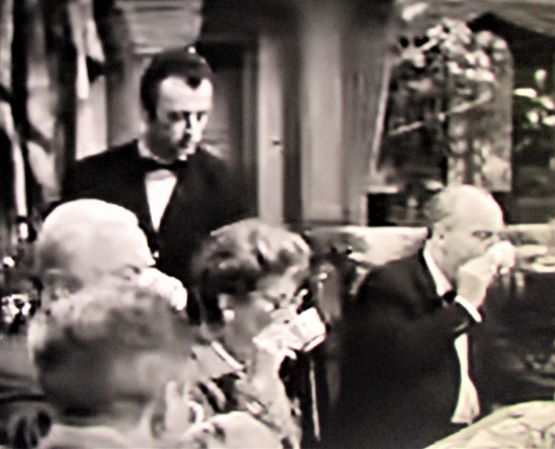
The Indian Scarf is a perfect and wacky whodunnit. An eccentric old man dies, the heirs gather like vultures, eager to get their share and run, only to find out that the pre-will stipulates they must all live together in the house for seven days before the real will is to be read. One by one, in rapid succession, they are killed off. Oh, and we are informed that there has been a flood so the peninsula is cut off, as is the phone. No escape and no way to call for help. The bodies are piling up in the chapel. Each victim is found with a distinctive scarf around the neck. Why does the killer leave the scarves? Does the killer have an endless supply of scarves? Scarf fetish perhaps? I wish I could tell you, but unless I hiccupped during the explanation and I missed it, none is given. There is a vague mention of India, but that’s about it.

This campy, atmospheric, wild ride has been compared to Clue for its pace and feel. As with Clue, the entire film takes place within a colossal and beautifully bizarre house. The set design, like the acting, is over the top. Now that I know the story, I will have to have another viewing just to take in all the props–wildly oversized flowers in jeroboams, massive statues, hidden passages, weird art and tchotchkes abound. In fact, early on, for no apparent reason, a box is lifted, releasing a tarantula. Why was there a tarantula there? No idea. Why was the box lifted? I couldn’t tell you. It made no sense in the storyline.

Eddi Arent as Richard Bonwit

Eddi Arent stands out with hilarious comedic talent as the butler–again much like Tim Curry in Clue or Hank Azaria’s Agador in The Birdcage (1996). Looking for a fun escape? This is IT! It’s on YouTube–see link below.

Link to film on YouTube:

https://www.youtube.com/watch?v=ms0HyB_NEq4

Link to blog on Edgar Wallace with list of books:

https://www.bookseriesinorder.com/edgar-wallace/

Link to list of Krimi films: https://mubi.com/lists/krimi-1959-1972

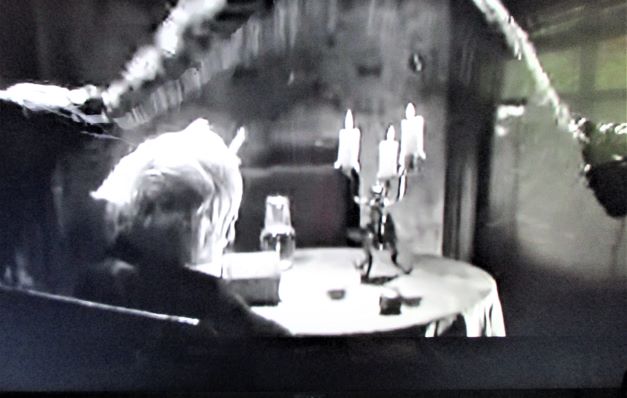
strangle scene from The Indian Scarf which I have to mention has some super sound effects

I give The Indian Scarf FIVE MONKEYS for weirdness and camp.

The Tenth Victim (1965)

I saw this movie when I was quite young. It’s not a great movie, but consider that American television at the time offered Green Acres, Leave it to Beaver, Bewitched, and the like… meanwhile, in Italy, there was this sexy, mod weird world where killing had become the ultimate reality show. Ahead of its time in some ways, perhaps. Has a catchy soundtrack I recorded on my tape recorder! The Internet Movie Data Base describes this movie as:The Tenth Victim (1965)