Morning Meditations with Cow Patties

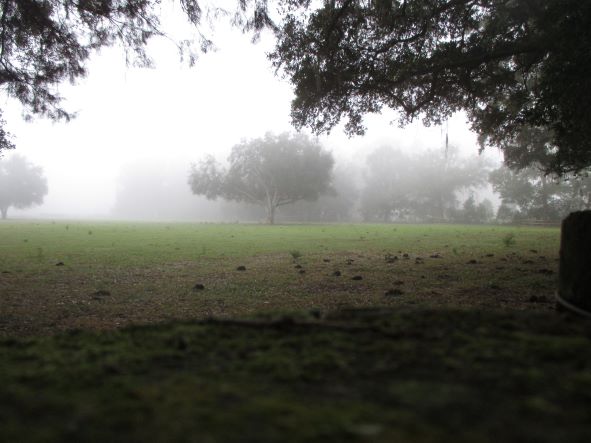
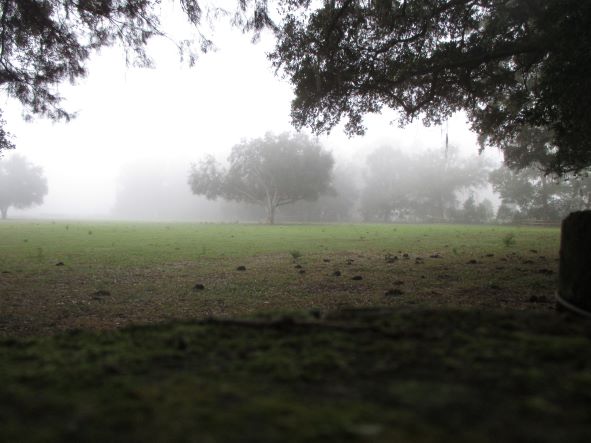
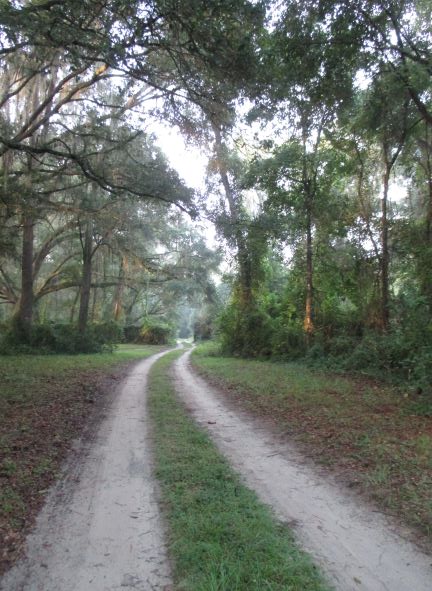
We enjoy our daily strolls much and I’ve gotten to really love this cow field. It’s nothing grand and yet ever changing. We’ve got three sandhill cranes who live nearby year round and deer that wander about. Sometimes cows, sometimes not. Bit of breeze, more so than in the woods.
Morning Meditation

At first glance, an empty field.

An empty field haphazardly filled with cow patties like a drunken checkerboard.

As always, so much that came before.

A leaf falls.

Distant rooster crows.

Flock of birds silently swoop by.

Way in the distance, the gray sandhills drop from the gray sky and casually stroll.

A leaf falls.

Birds twitter nearby.

A couple miles away, the Most Disgruntled Employee, an eighteen wheeled rig complains along the interstate.

The cow patties rest. Or do they?

Perhaps under each pile, a crew of dung beetles like Snow White’s comrades, is whistling while they work their pickaxes.

Or humming.

Or meditating.

Some heaps resemble sand castles; others quite symmetrically round.

The cows are in another pasture this morning, doing their cow things.

Yesterday seven calves, shoulder to shoulder, awaited–what?

A photo shoot?

Oranges?

No doubt, I disappointed.

Breeze swings a tendril of Spanish moss.

The sandhills have disappeared behind the red tractor.

(Yes, WCW, so much depends on that red tractor, too, we know.)

Dragonfly lands on the barbed wire.

A leaf falls.
Twig Ants / Oak Ants

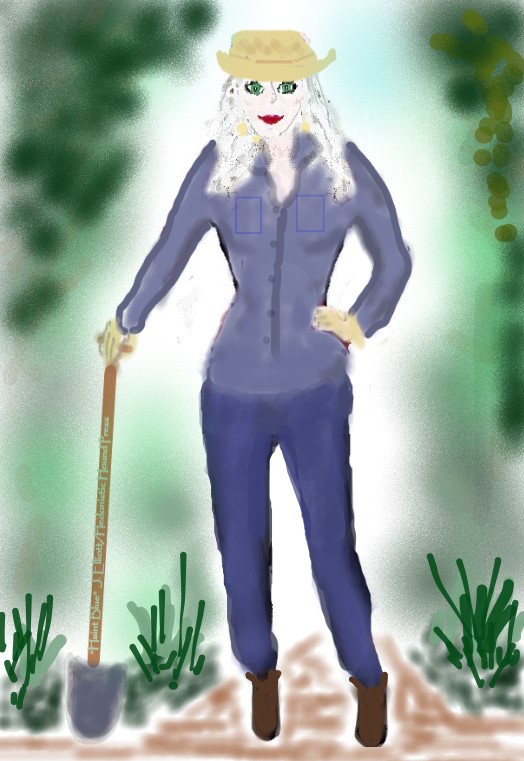
So, I’m having one of those nothing-going-right days, and feeling pretty darned bleak about the state of the world today. Thought I’d take advantage of the tropical depression and take my aggressions out on some coral ardisia sprouting up in the woods. Got the bug spray, gloves, shovel, heavy-duty trash bags and set off. Dug up one big mama of an ardisia that had deep roots and tiny baby pups all around. Felt good to dig that up.

And then there was this repeated stinging sensation on my leg. Whipped my pants down and could not find the culprit. Shook them out. Pulled them back up.

Ouch! Another sting, higher up. Did the pants on the ground and the sweeping and the shaking. Didn’t find the culprit. I recognize the sting. I know who it was. According to a webpage called Green Pest Services Florida Ant Identification Guide (link below for full article), our culprit is the twig ant:

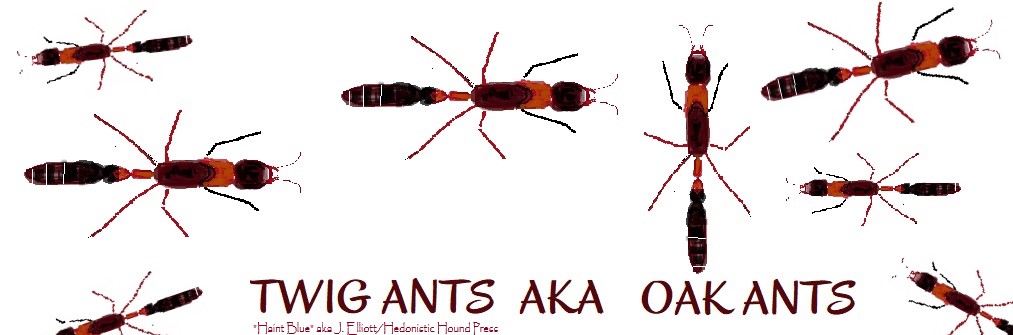
“The Mexican Twig Ant (Pseudomyrmex gracilis) sometimes referred to as an Oak Ant or Tree Ant, is a relatively minor pest on the Treasure Coast because they rarely come into homes. They are however quite numerous and common around homes and in commercial landscapes. These long thin ants are orange and black and typically found as single individuals. A sharp eye can spot one almost anywhere outdoors in South Florida. They prefer to live in trees and hedges and use their painful sting to defend their territory. Anyone having to do any tree trimming or landscaping runs the risk of becoming acquainted with this ants defense mechanism.”

Funny how it says a sharp eye can spot them. This is probably true. I don’t have sharp eyes. I only find them when I’m madly hunting through my clothing. I never see them in trees. If you live in a residential area in Florida with lawn service and pest control, you probably won’t encounter these demons. I live out in the woods and get to enjoy nature to its fullest: the ticks, mosquitoes, chiggers, and twig ants. It makes me feel better to read that they bite “defending their territory”. I thought it was just random sadistic pleasure, honestly. I have yet to invite one of these things into my wardrobe. But to be fair, perhaps I missed some frantic waving “No, go back! Get away!” from a tree branch.

I dunno. I don’t like them. I came inside, put some salve on and sat down to write this.

May your day be blessed and twig ant free.

Here’s the link to the full Florida Ants Identification Guide I mentioned:

https://greenpestservicesfl.com/florida-ant-identification-guide-list-of-stinging-biting-ants-in-florida/

Twig Ant bites 2 days later

Horse nettle/ Solanum Carolinense/bull nettle or “Devil’s tomato”

I’ve said this elsewhere, but it bears repeating, how in the world did Henry Flagler and other settlers decide to live in Florida? We’ve got humidity, scorching sun, a plethora of bugs that want to eat you: ticks, mosquitoes, chiggers, yellow flies, biting ants, fire ants, alligators, venomous snakes and toxic toads.

As if that’s not enough, no, we’ve also got invasive plants that are either out to get you or will just swallow everything, or both: poison ivy, green briar, black raspberries (wicked thorns!), stinging nettles, Devil’s walking stick, air potato, wisteria, Virginia creeper, poison oak, and Devil’s tomatoes. And lucky me, I’ve got all but the poison oak on my property.

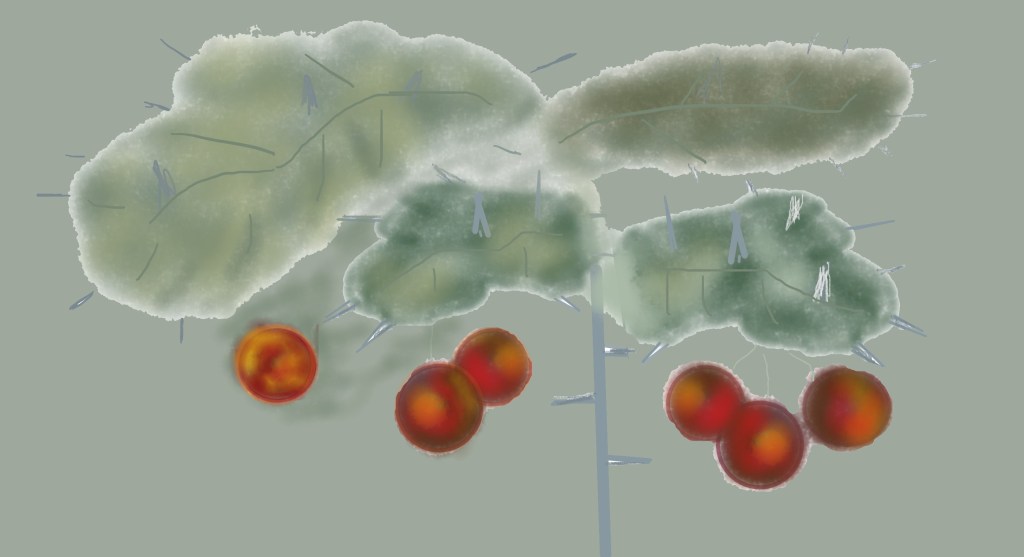
Devil tomato plant sketch from memory as I couldn’t find one to photograph at the time of this post

The Devil’s tomato was a surprise. I’d never heard of it before. I was clearing an area completely overgrown with weeds and oak saplings when this glimmer of color caught my attention. For all the world, it looked like a little cherry tomato plant…until I got closer and saw the hellish spikes all over it, on the stem, jutting out from the sides of the leaves, and set like daggers coming right out of the leaf surfaces themselves. I carefully dug it out and bagged it. When the area was clear enough, I got the mower in. I felt sure I’d gotten it. But no, the next year, there were more. And now I keep finding little starts coming up around the yard.

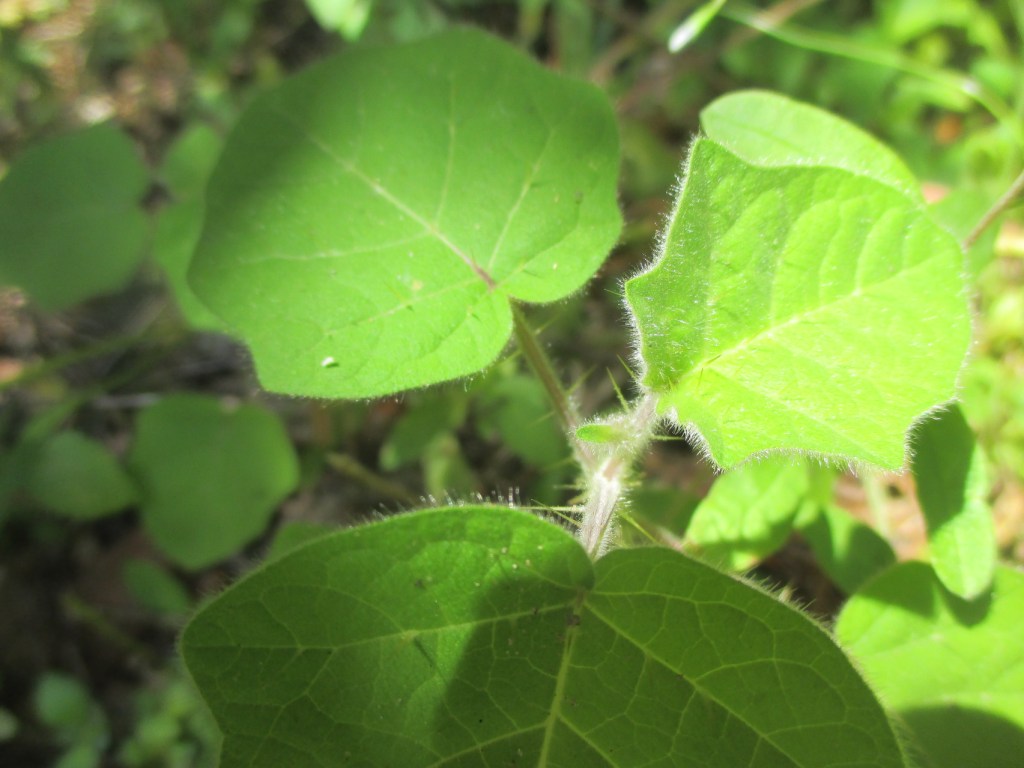
Hah! Found a little one after I posted this originally. See the “fuzz” on the leaves? Not friendly fuzz like a geranium. No petting!

Links to articles:

https://en.wikipedia.org/wiki/Solanum_carolinense

https://duckduckgo.com/?q=horse+nettle&t=h_&iax=images&ia=images&iai=https%3A%2F%2Fthumbs.dreamstime.com%2Fb%2Fpoisonous-horsenettle-solanum-carolinense-plant-berries-horse-nettle-82532033.jpg

Wicked Thistles

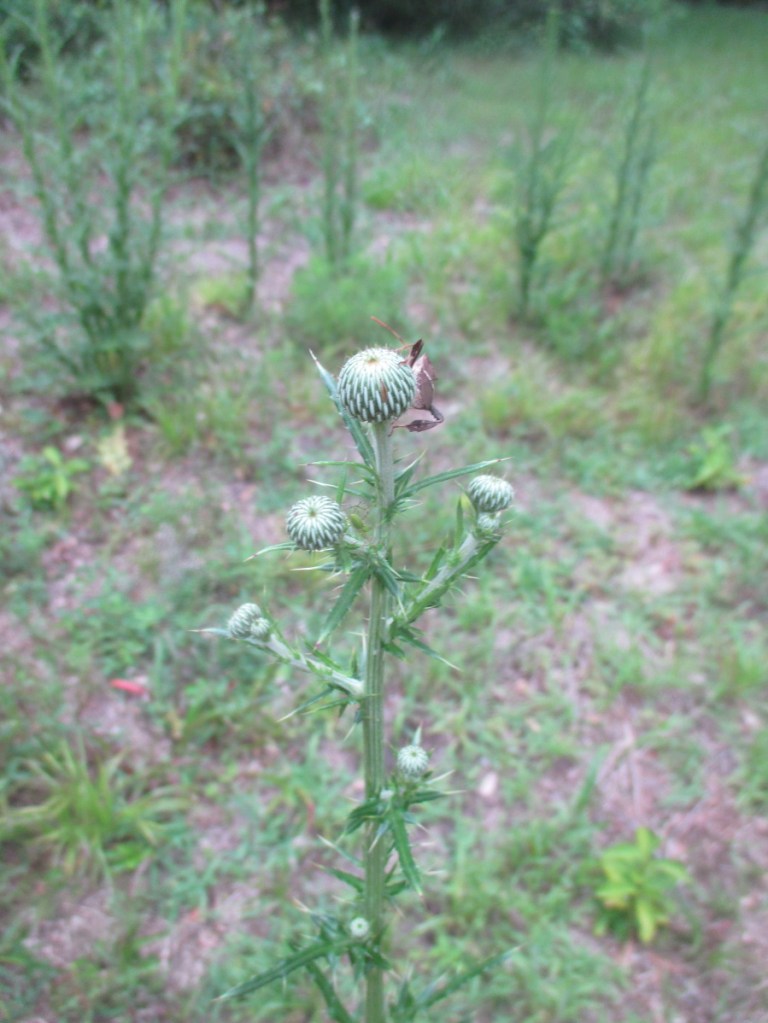
Thistle budding

Last year, there was one thistle rosette in the ground. Curious to see what it would do, I let it be. It grew tall and proud, almost bust high. Robust, if you will. Well, perhaps the butterflies will like it, I thought.

This year, we have a thistle circle. At the risk of offending any local pixies or fairies or nagas, I will be shoveling them out before the thistles set seeds as, to my horror, according to IFAS, one plant can send out 4,000 seeds…

A word to the wise. If you see a rosette, dig it up. Don’t be me. There is a perfectly terrifying photo in the article below with a field covered in these spikey, hearty thistles. Of course, if you wanted to create a no-man’s (or any creature) land, this would be quite effective.

University of Florida article: http://blogs.ifas.ufl.edu/bakerco/2020/02/01/thistle/

and : https://edis.ifas.ufl.edu/publication/AG253

Stinging Nettle

This is a common plant in Florida…the stinging nettle. In my yard at least, they seem to love growing in full sun in an open field. The leaves and stem are covered in little needles–a brush against one of these plants with bare skin causes an immediate stinging reaction, much like a jellyfish.
Fortunately, the sting doesn’t persist and can be soothed with most balms like calamine or witch hazel or an antihistamine cream. Bees and butterflies love the flowers, and evidently, this is a medicinal plant that when processed properly can be eaten. Please research further if you plan to attempt this as it apparently has to be done a certain way with young plants that haven’t bloomed yet.

I haven’t fooled with it.

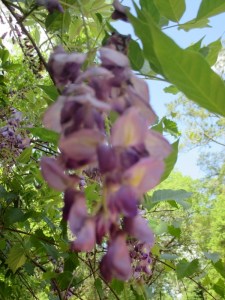
Wisteria

Wisteria… love it or hate it… don’t plant it anywhere close to buildings… 

I love it and have it all over my fences, but it does want to climb trees.  It will spiral upward and bush out –gorgeous, but eventually it can shade out a tree…

It blooms in early spring and the flowers are so deliciously fragrant–if the breeze is right, it can be almost overpowering. It comes in white and lavender. 

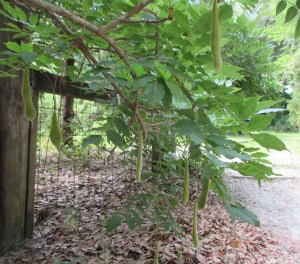
This is the first year I’ve noticed pods on my vines! The pods appeared at the end of May, two months after the flowers.  I had no idea it put out pods, I thought it just sent out runners. (It does this too.)

Turns out, the pods have seeds, much like pea pods– toxic to humans and animals if eaten. Surprisingly, considering how quickly a vine can run up a tree, it takes 15 years for a seed to grow into a plant old enough to flower. Guess I’ve got mature vines! 

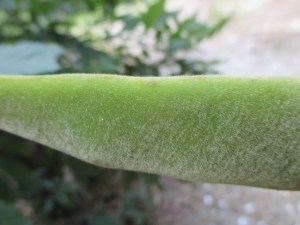
The pods are velvety to touch and are about as long as my hand.

Florida Trivia– Did You Know?

 Following are 25 facts about Florida taken from 50States.com.

Do you know?    

1. Saint Augustine is the oldest European settlement in North America.
2. Orlando attracts more visitors than any other amusement park destination in the United States.
3. New England Congregationalists who sought to bring their style of liberal arts education to the state founded Rollins College, the oldest college in Florida, in Winter Park in 1885.
4. Florida is not the southernmost state in the United States. Hawaii is farther south.
5. A museum in Sanibel owns 2 million shells and claims to be the world’s only museum devoted solely to mollusks.
6. Safety Harbor is the home of the historic Espiritu Santo Springs. Given this name in 1539 by the Spanish explorer Hernando de Soto. He was searching for the legendary Fountain of Youth. The natural springs have attracted attention worldwide for their curative powers.
7. The United States city with the highest rate of lightning strikes per capita is Clearwater.
8. Gatorade was named for the University of Florida Gators where the drink was first developed.
9. Dr. John Gorrie of Apalachicola invented mechanical refrigeration in 1851.
10. Miami Beach pharmacist Benjamin Green invented the first suntan cream in 1944. He accomplished this development by cooking cocoa butter in a granite coffee pot on his wife’s stove.
11. Key West has the highest average temperature in the United States.
12. The Saint John’s River is one of the few rivers that flows north instead of south.
13. May 20, 1970 Florida lawmakers passed and sent to the Governor a bill adopting the moonstone as the official state gem. Ironically, the moonstone is not found naturally in Florida…nor was it found on the moon.
14. In 1987 the Florida legislature designated the American alligator (Alligator mississippiensis) the official state reptile. Long an unofficial symbol of the state, the alligator originally symbolized Florida’s extensive untamed wilderness and swamps.
15. Miami installed the first bank automated teller machine especially for rollerbladers.
16. Ybor City was once known as the Cigar Capital of the World with nearly 12,000 tabaqueros (cigar-makers) employed in 200 factories. Ybor City produced an estimated 700 million cigars a year at the industry’s peak.
17. Plant City, the Winter Strawberry Capital of the World, holds the Guinness record for the world’s largest strawberry shortcake. The 827 square-foot, 6,000 pound cake was made on Feb. 19, 1999 in McCall Park.
18. The Sunshine Skyway Bridge is a cable-stayed concrete bridge. Opened in 1987 the bridge coasts through the clouds at 190 feet above water. Its bright yellow support cables spread from the two center pillars. The structure gives drivers unobstructed view of the water during the 4.1 mile trip over Tampa Bay.
19. Fort Lauderdale is known as the Venice of America because the city has 185 miles of local waterways.
20. Fort Meade is the oldest settlement in Polk County. It dates back to 1849 when a settlement grew up around the United States Cavalry fort during the Seminole Indian Wars.
21. Islamorada is billed as the Sports fishing Capital of the World.
22. Fort Zachary Taylor in Key West was built between 1845 and 1866. Controlled by the Union during the Civil War, the fort was the home base for a successful blockade of Confederate ships that some historians say shortened the conflict by a full year. The fort also was active during the Spanish-American War, World War I, and World War II.
23. During the 1991 Gulf War the busiest military port in the country was Jacksonville. From this location the military moved more supplies and people than any other port in the country.
24. When first completed in 1989 the Dame Point Bridge became the longest cable-stayed span in the United States, the longest concrete span of its type in the Western Hemisphere, and the third longest cable-stayed bridge in the world.
25. Venice is known as the Shark Tooth Capital of the World. Collecting prehistoric sharks teeth has been a favorite pastime of visitors and residents of the Venice area for years

Chiggers or Red Bugs

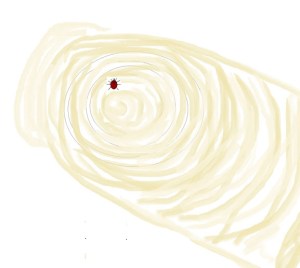
Chiggers are tiny little reddish mites that live in grass and woodsy areas that love love love to sneak up under your clothes, preferably along a bra, underwear or sock line where its warm and snug. 
The common Southern solution for bites is to apply a dab of nail polish. The idea is that the mite has burrowed into the skin and the nail polish seals off its oxygen supply so it dies. Apparently this is a myth. According to several recent articles on the subject, by the time the bite itches, the mite has moved on or been washed off. It can take 24 to 48 hours for the itching to start.  The mite didn’t burrow in at all, but secreted a skin liquefying substance around a hair follicle, and drinks the juice.  The nail polish method does stop the itching, but so would a cortisone cream or a dab of meat tenderizer.
  When going in the woods, it’s best to use an insect repellent and tuck your pants into your socks so the ticks and mites don’t have easy access. If you plan on a picnic, do set out a blanket. Resting on a big log while wearing short shorts a tank top is an invitation for the bugs to convene for their own picnic.
But don’t make this  a reason to avoid a lovely hike in the woods.  
I’m not crazy about chemical stuff, there are some less toxic products available that work pretty well. And best to take a shower with a mildly abrasive soap or brush as soon as you can after your hike. 
Chigger bites itch like all get out, but unless you are prone to skin rashes and allergies, they aren’t usually any more harmful or lasting than mosquito bites. 


Poison Ivy VS. Virginia Creeper : How to Identify

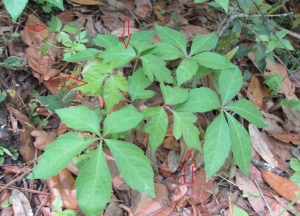
Look carefully at this photo. It’s a perfect example of how sneaky poison ivy can be; it likes to hide in other plants.  See my red arrows? The jaggedy-edged, three-leaf jobbie is the poison ivy. The five-leaf stuff is Virginia Creeper. Both have hairy vines, both can grow up trees. They will lose their leaves in winter, and come back with a vengeance at the first sign of spring. 

Never try to get rid of poison ivy by burning it! The oil particles get get into your lungs and your nose. If anyone has a non-chemical solution for getting rid of big areas of it, let me know. If I find one or two, I’ll dig it out with a shovel and toss it… but when it gets aggressive and dense… that’s something else.

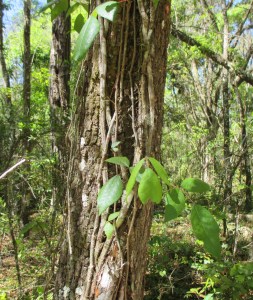
  Yup! That’s poison ivy working its way up a tree!
The leaves can vary in size and jaggedy-ness, but they’re always in three-leaf clumps.

Don’t lean against a tree or hug it if you see hairy vines or three-leave clusters!


Florida Invasive: Coral Ardisia

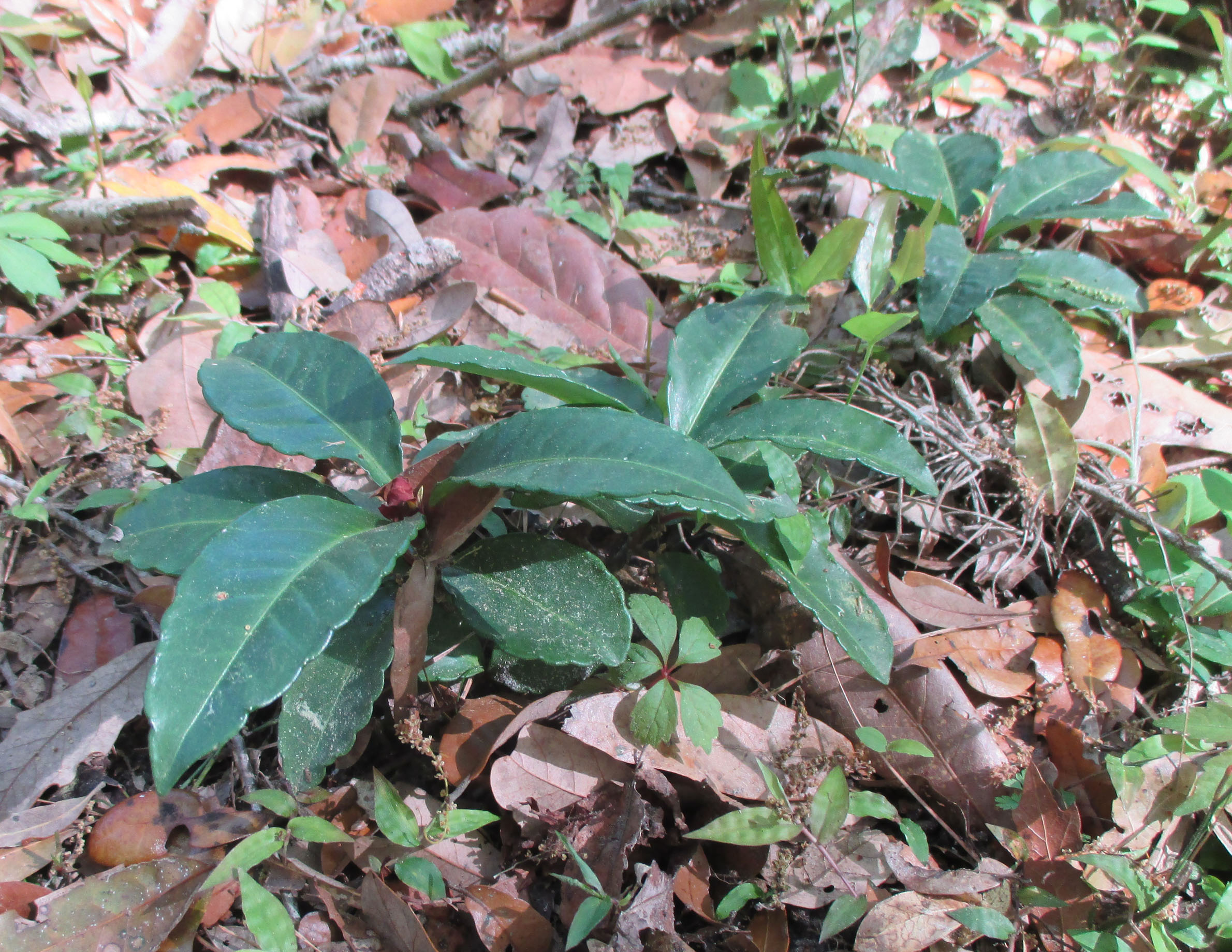
brazilian pepper plant small pupsSadly, you’ll think this is a lovely plant. Hardy and perfect deep green with red berries, perfect for Christmas decorating, right? Sorry! This is one of the most invasive plants in Florida… and it’s classified in with skin irritating plants like poison ivy and poison oak!

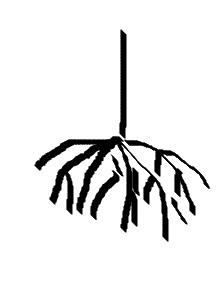
The hardy little pups spring up in communities like this with an impressive,  reverse- umbrella root system : Fortunately, they’re fairly easy to pull up when they are pups.  If you see one on your property, don’t cave to its luster! Yank it with gusto before it sets berries. Once it establishes on your property, you’ll lose many hours of your life eradicating it. 
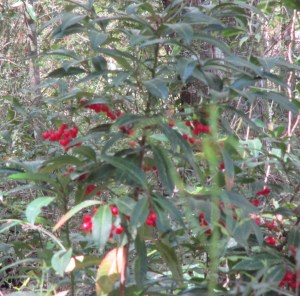
“It has many names
Common names include coral ardisia, coral berry, Christmas berry, hen’s eyes, scratch throat, Australian holly, coral bush and spiceberry.”

https://www.floridamuseum.ufl.edu/science/five-facts-about-coral-ardisia-in-florida/